
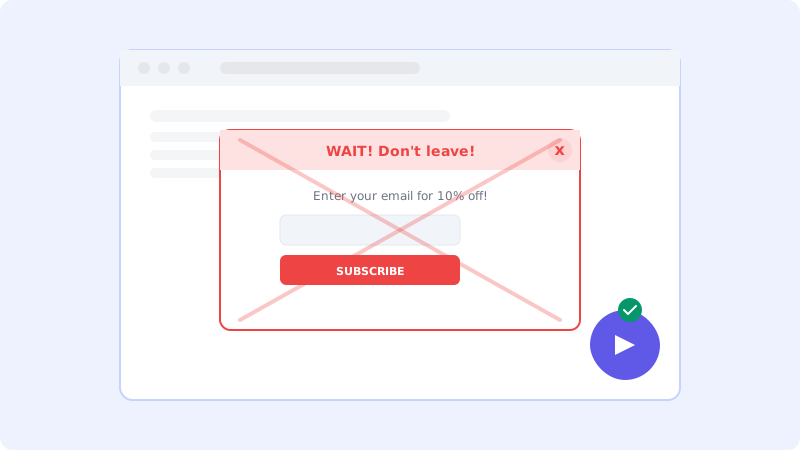
Nobody likes pop-ups. Nobody.
You land on a website. Before you even read the first sentence, a box appears in the middle of the screen. "WAIT! Before you go..." or "Sign up for our newsletter!" You close it. Maybe another one appears 30 seconds later. By then you are already annoyed and thinking about leaving.
This is how most websites try to capture attention. And it barely works anymore.
The numbers tell the story
The average pop-up conversion rate is around 3% (Sumo, based on 2 billion pop-ups). That means 97 out of 100 people close it without doing anything. Some studies put it even lower at 1-2% for generic pop-ups.
But here is the real problem: those numbers do not account for the damage. How many people bounced because the pop-up annoyed them? How many will never come back? That is much harder to measure, but anyone who has used the internet knows the answer. It is a lot.
Google knows this too. They started penalizing mobile pages with intrusive interstitials back in 2017. If your pop-up covers the main content on mobile, your search ranking takes a hit.
Why pop-ups stopped working
People got used to them. When pop-ups first appeared, they were new and surprising. People actually read them. Now everyone has trained themselves to close any box that appears on screen without even looking at what it says.
There is also the trust problem. Pop-ups feel desperate. When a website throws a discount code at you before you have even seen the product, it signals that they are struggling to get sales. Not exactly the vibe you want for your brand.
And then there is timing. Most pop-ups show up way too early. The visitor just arrived. They have not read anything yet. They have no idea what you sell. Why would they give you their email? You would not ask someone to marry you on the first date, but that is basically what early pop-ups do.
What actually works instead
The key insight is simple: people do not hate being engaged. They hate being interrupted. There is a big difference.
A video bot sitting in the corner of your screen is not an interruption. It does not block the content. It does not demand your attention. It just sits there, maybe with a small preview showing a friendly face, and waits. If you are interested, you click. If not, you ignore it. No pressure.
But here is why it works better than a pop-up: when someone does click, they see a real person talking to them. That is infinitely more engaging than a text box asking for an email address. Video builds trust in seconds. A pop-up never can.
The engagement difference
Think about it from the visitor's perspective:
Pop-up experience: I am reading something. A box covers the screen. I am annoyed. I close it. I might leave the site entirely.
Video bot experience: I notice a small video widget in the corner. I am curious. I click. A person greets me and explains what this company does. There are buttons I can click: "See pricing", "Book a demo", "Chat with us". I feel welcome, not pressured.
Which experience would make you more likely to buy?
When pop-ups can still work
To be fair, not all pop-ups are terrible. Exit-intent pop-ups (shown only when the cursor moves toward the close button) perform better because the person was leaving anyway. You have nothing to lose.
Timed pop-ups that appear after 60+ seconds also work better than immediate ones. By then the visitor has at least seen your content and has some context.
But even in these cases, a video bot with the same offer will almost always outperform a text pop-up. "Hey, before you go, here is a quick 15-second explanation of what we do" is more compelling than "WAIT! Enter your email for 10% off!"
Making the switch
If your website currently uses pop-ups, try this: keep the pop-up running on half your traffic and add a video bot for the other half. Run it for two weeks and compare. Look at bounce rate, time on site, and actual conversions, not just pop-up clicks.
Most businesses that run this test end up removing the pop-up entirely. The video bot does not just convert better. It makes the whole website experience feel more professional and human. (We covered the conversion data in detail in How Video Bots Increase Website Conversions by 40%.)
You do not need fancy equipment. Record a 20-second welcome message with your phone (we put together a quick guide on recording a marketing video with just your phone), upload it, and set it up in minutes. That is all it takes to replace the most annoying thing on the internet with something people actually want to interact with.