
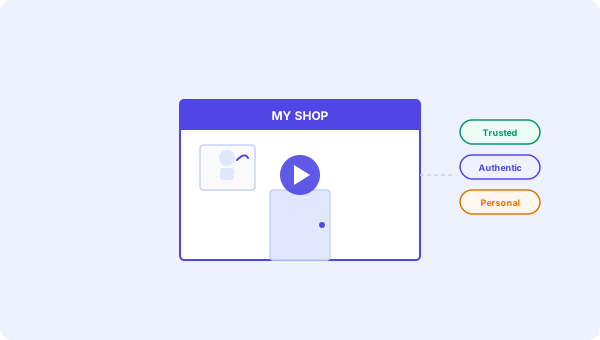
People buy from people they trust
If you run a small business, you already know this. When a customer walks into your store or office, you greet them, answer their questions, and build a relationship. That personal connection is your biggest advantage over big corporations.
But online, that advantage disappears. Your website looks like every other website. A logo, some text, maybe a few stock photos. Nothing that says "there is a real human being behind this business."
That is exactly what video fixes.
Why video builds trust faster than anything else
A study by Brightcove found that 93% of B2B buyers say video builds trust in a brand. And Animoto reported that 58% of consumers consider businesses that produce video content more trustworthy.
These numbers make sense if you think about how trust actually works. We trust people we can see and hear. That is hardwired into our brains. Reading text on a screen does not trigger the same response. Seeing someone's face and hearing their voice does.
For small businesses, this is a massive opportunity. You do not need a marketing department or a video production team. You just need your phone and something honest to say.
What real small businesses are doing
Local service providers. A plumber in Austin records a 20-second video for his website: "Hey, I'm Mike. I've been fixing pipes in Austin for 12 years. If something is leaking, I can usually get there same day. Just click below to call or text me." That video gets more calls than his entire About page.
Online shops. A woman who sells handmade candles records a video showing her workshop, the ingredients she uses, and how she pours each candle by hand. Customers see the care that goes into the product. Returns go down. Repeat orders go up.
Consultants and freelancers. A business coach puts a welcome video on her homepage. She talks for 20 seconds about who she helps and how. Potential clients say they "feel like they already know her" before the first call. That shortens the sales cycle dramatically.
Restaurants and cafes. A cafe owner records the barista making a signature drink, then adds a "See our menu" button. People walking by check the website, see a real person making real coffee, and walk in.
None of these videos required a budget. None of them used a script. They are just real people showing what they do.
You do not need to be on camera if you really hate it
Some people genuinely cannot stand being on camera. That is okay. There are alternatives.
Show your product instead of your face. A hands-on demo of what you sell or what you do works almost as well. A carpenter can show the wood, the tools, the finished piece. A baker can show the dough rising, the icing going on, the final product.
Use a screen recording. If you sell software or online services, record your screen while you walk through the main features. Add your voice on top. People hear you, even if they do not see you.
Use a mascot or an animated character. Some brands create a simple character that represents them. It adds personality without requiring anyone to be on camera. We did this ourselves with our mascot Koomi for our demo videos.
But if you can get on camera, do it. Nothing replaces a real face.
Where to put your videos for maximum trust
Not every page needs a video. But a few key spots make a big difference.
Homepage. This is where most first impressions happen. A short welcome video here is worth more than any amount of copywriting.
About page. If someone clicks "About," they want to know who you are. A video here is the perfect answer.
Product or service pages. Show what you do, not just describe it. A 30-second demo builds more confidence than a paragraph of text.
Contact page. A quick "We would love to hear from you" video makes people more likely to fill out the form. It feels less like submitting a request into a void and more like reaching out to a person.
You can use page targeting to automatically show different videos on different pages without managing multiple embed codes.
The trust gap that big companies cannot close
Big brands spend millions on polished marketing videos. They look perfect. But perfect can feel fake. People know that the smiling actors in a corporate video are not actual employees. They know the testimonials are carefully selected and scripted.
Small businesses have something corporations cannot buy: authenticity. When you record a video in your actual office, workshop, or kitchen, people see the real thing. That roughness around the edges is not a weakness. It is proof that you are genuine.
A Stackla report found that 86% of consumers say authenticity is a key factor when deciding which brands they support. And 57% say less than half of brands create content that feels authentic. That gap is where small businesses win.
Start with one video
You do not need a content strategy. You do not need a video marketing plan. You need one video on one page.
Pick your homepage. Record 20 seconds. Say who you are, what you do, and how to get started. Upload it, add a button or two, and put it on your site.
That one video will do more for trust than redesigning your entire website. Your competitors are still hiding behind stock photos and generic text. Show your face and you are already ahead.
Try it free. No credit card, no commitment. Just a real video on your real website.